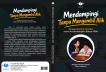
Mendampingi Tanpa Mengambil Alih Strategi Shadow Teacher dalam Mengembangkan Bahasa PDBK
Synopsis
Buku ini membahas peran shadow teacher dalam pendampingan perkembangan bahasa Peserta Didik Berkebutuhan Khusus (PDBK) melalui sudut pandang psikolinguistik. Pembahasan diarahkan pada bagaimana proses memahami bahasa, menghasilkan dalam Mengembangkan Bahasa PDBK bahasa, dan menggunakan bahasa dalam interaksi sosial dapat didukung melalui pendampingan yang tepat di lingkungan pendidikan inklusif.
Shadow teacher adalah pendamping belajar yang hadir untuk membantu PDBK mengikuti proses pembelajaran, memahami tuntutan kelas, mengelola kebutuhan belajar, serta berpartisipasi dalam interaksi akademik dan sosial. Dalam konteks perkembanganbahasa, shadow teacher memiliki fungsi strategis karena berada dekat dengan pengalaman komunikasi anak sehari-hari. la dapat mengamati bagaimana anak memahami instruksi, merespons pertanyaan, meminta bantuan, menyampaikan pilihan, menolak, menyapa, bergiliran bicara dan menggunakan bahasa untuk membangun hubungan dengan orang lain.
Downloads
Download data is not yet available.
References
Adams, C., Lockton, E., Freed, J., Gaile, J., Earl, G., McBean, K., Nash, M., Green, J., Vail, A., & Law, J. (2012). The Social Communication Intervention Project: A randomized controlled trial of the effectiveness of speech and language therapy for school-age children who have pragmatic and social communication problems with or without autism spectrum disorder. International Journal of Language & Communication Disorders, 47(3), 233-244. https://doi.org/10.1111/j.1460-6984.2011.00146.x
American Speech-Language-Hearing Association. (n.d.). Social communication disorder. ASHA Practice Portal. https://www.asha.org/practice-portal/clinical-topics/social-communication-disorder/
American Speech-Language-Hearing Association. (n.d.). Spoken language disorders. ASHA Practice Portal. https://www.asha.org/practice-portal/clinical-topics/spoken-language-disorders/
Bellini, S., Peters, J. K., Benner, L., & Hopf, A. (2007). A meta-analysis of school-based social skills interventions for children with autism spectrum disorders. Remedial and Special Education, 28(3), 153-162. https://doi.org/10.1177/07419325070280030401
Bishop, D. V. M. (1997). Uncommon understanding: Development and disorders of language comprehension in children. Psychology Press.
Bishop, D. V. M., & Norbury, C. F. (2002). Exploring the borderlands of autistic disorder and specific language impairment: A study using standardised diagnostic instruments. Journal of Child Psychology and Psychiatry, 43(7), 917-929. https://doi.org/10.1111/1469-7610.00114
Bloom, L., & Lahey, M. (1978). Language development and language disorders. John Wiley & Sons.
Cirrin, F. M., & Gillam, R. B. (2008). Language intervention practices for school-age children with spoken language disorders: A systematic review. Language, Speech, and Hearing Services in Schools, 39(1), S110-S137. https://doi.org/10.1044/0161-1461(2008/012)
Dockrell, J. E., Lindsay, G., Roulstone, S., & Law, J. (2014). Supporting children with speech, language and communication needs: An overview of the results of the Better Communication Research Programme. International Journal of Language & Communication Disorders, 49(5), 543-557. https://doi.org/10.1111/1460-6984.12089
Ebbels, S. H. (2014). Effectiveness of intervention for grammar in school-aged children with primary language impairments: A review of the evidence. Child Language Teaching and Therapy, 30(1), 7-40. https://doi.org/10.1177/0265659013512321
Fey, M. E. (1986). Language intervention with young children. College-Hill Press.
Friend, M., & Bursuck, W. D. (2019). Including students with special needs: A practical guide for classroom teachers (8th ed.). Pearson.
Girolametto, L., & Weitzman, E. (2002). Responsiveness of child care providers in interactions with toddlers and preschoolers. Language, Speech, and Hearing Services in Schools, 33(4), 268-281. https://doi.org/10.1044/0161-1461(2002/022)
Gray, C. A., & Garand, J. D. (1993). Social stories: Improving responses of students with autism with accurate social information. Focus on Autistic Behavior, 8(1), 1-10. https://doi.org/10.1177/108835769300800101
Gresham, F. M., & Elliott, S. N. (2008). Social Skills Improvement System: Rating scales manual. Pearson Assessments.
Hodgdon, L. A. (1995). Visual strategies for improving communication: Practical supports for school and home. QuirkRoberts Publishing.
Kamps, D., Thiemann-Bourque, K., Heitzman-Powell, L., Schwartz, I., Rosenberg, N., Mason, R., & Cox, S. (2015). A comprehensive peer network intervention to improve social communication of children with autism spectrum disorders: A randomized trial in kindergarten and first grade. Journal of Autism and Developmental Disorders, 45(6), 1809-1824. https://doi.org/10.1007/s10803-014-2340-2
Kaiser, A. P., & Roberts, M. Y. (2013). Parents as communication partners: An evidence-based strategy for improving parent support for language and communication in everyday settings. Perspectives on Language Learning and Education, 20(3), 96-111. https://doi.org/10.1044/lle20.3.96
Law, J., Garrett, Z., & Nye, C. (2003). Speech and language therapy interventions for children with primary speech and language delay or disorder. Cochrane Database of Systematic Reviews, 2003(3), CD004110. https://doi.org/10.1002/14651858.CD004110
Light, J., & McNaughton, D. (2014). Communicative competence for individuals who require augmentative and alternative communication: A new definition for a new era of communication? Augmentative and Alternative Communication, 30(1), 1-18. https://doi.org/10.3109/07434618.2014.885080
McLoughlin, J. A., Lewis, R. B., & Kritikos, E. P. (2018). Assessing students with special needs (8th ed.). Pearson.
Owens, R. E. (2022). Language development: An introduction (10th ed.). Pearson.
Paul, R., Norbury, C. F., & Gosse, C. (2018). Language disorders from infancy through adolescence: Listening, speaking, reading, writing, and communicating (5th ed.). Elsevier.
Peraturan Menteri Pendidikan, Kebudayaan, Riset, dan Teknologi Republik Indonesia Nomor 48 Tahun 2023 tentang Akomodasi yang Layak untuk Peserta Didik Penyandang Disabilitas pada Satuan Pendidikan Anak Usia Dini Formal, Pendidikan Dasar, Pendidikan Menengah, dan Pendidikan Tinggi.
Salvia, J., Ysseldyke, J. E., & Witmer, S. (2017). Assessment in special and inclusive education (13th ed.). Cengage Learning.
Snowling, M. J., & Hulme, C. (2012). Interventions for children's language and literacy difficulties. International Journal of Language & Communication Disorders, 47(1), 27-34. https://doi.org/10.1111/j.1460-6984.2011.00081.x
Snowling, M. J., Hulme, C., & Nation, K. (Eds.). (2022). The science of reading: A handbook (2nd ed.). Wiley-Blackwell.
Stokes, T. F., & Baer, D. M. (1977). An implicit technology of generalization. Journal of Applied Behavior Analysis, 10(2), 349-367. https://doi.org/10.1901/jaba.1977.10-349
Tomasello, M. (2003). Constructing a language: A usage-based theory of language acquisition. Harvard University Press.
Undang-Undang Republik Indonesia Nomor 8 Tahun 2016 tentang Penyandang Disabilitas.
UNESCO. (1994). The Salamanca statement and framework for action on special needs education. UNESCO.
Vygotsky, L. S. (1978). Mind in society: The development of higher psychological processes. Harvard University Press.
Watkins, L., O'Reilly, M., Kuhn, M., Gevarter, C., Lancioni, G. E., Sigafoos, J., & Lang, R. (2015). A review of peer-mediated social interaction interventions for students with autism in inclusive settings. Journal of Autism and Developmental Disorders, 45(4), 1070-1083. https://doi.org/10.1007/s10803-014-2264-x
Wood, D., Bruner, J. S., & Ross, G. (1976). The role of tutoring in problem solving. Journal of Child Psychology and Psychiatry, 17(2), 89-100. https://doi.org/10.1111/j.1469-7610.1976.tb00381.x
Yoder, P. J., & Warren, S. F. (2002). Effects of prelinguistic milieu teaching and parent responsivity education on dyads involving children with intellectual disabilities. Journal of Speech, Language, and Hearing Research, 45(6), 1158-1174. https://doi.org/10.1044/1092-4388(2002/094)
Published
October 12, 2026
Categories
Copyright (c) 2026 Mixghan Norman Antono, Wevi Lutfitasari (Author)

How to Cite
Antono, M. N., & Lutfitasari, W. (2026). Mendampingi Tanpa Mengambil Alih Strategi Shadow Teacher dalam Mengembangkan Bahasa PDBK. PT. Ghani Press Group. https://e-book.ghanipress.com/index.php/ghanipress/catalog/book/137